China 2026 Geopolitical Risk Assessment: The Overstretch

Updated: 3 days ago

Originally published Aug 30, 2026 · Updated: Sep 29, 2026
Contents
Key Takeaways
Deep-seated deceleration, not cyclical downturn. Q2 2026 GDP growth fell to 4.3% YoY, down from 5.0% in Q1, the weakest pace in 3.5 years; half-year growth came in at 4.7%. Fixed-asset investment contracted 5.7% YoY in H1, with property-related investment having nearly halved since its 2021 peak, and new-home prices set to fall a further 2.8% this year. Exports are booming — up 25% YoY in August — but cannot offset a property sector that consumed an estimated 25-30% of GDP at its peak. This is the unwinding of a growth model, not a transient slowdown, and it is now highly likely that growth settles in a 4-4.5% band through 2027.
The PLA is being rebuilt mid-flight — and the purge has moved from investigation to punishment. Zhang Youxia, CMC vice-chairman and the second-most powerful figure in the military hierarchy, and Liu Zhenli, Joint Staff Department chief, were formally expelled from the Party in late September 2026 for taking "exceptionally large" bribes and political disloyalty. The seven-member CMC retains only two active members: Xi himself and General Zhang Shengmin. On 24 August, the PLA publicly solicited corruption reports on the Rocket Force after four consecutive commanders were purged. With 40+ Central Committee expulsions expected at the October plenum, degraded short-term readiness paired with elevated medium-term miscalculation risk defines the military corridor to the 2027 Party Congress.
Export controls have backfired — at the mature nodes, not the frontier. Huawei projects a 60% jump in chip revenue in 2026 and its Ascend line now competes with Nvidia domestically; SMIC posted record revenue of $9.3 billion in 2025, up 16%. Independent assessment nonetheless puts total Huawei compute output at roughly 25× below Nvidia's for 2026. Both facts are true, and together they define a likely outcome: a bifurcated semiconductor market, with the mainland dominant at mature nodes and constrained at the bleeding edge.
Grey zone coercion is the operational baseline, not an escalatory tool. ACLED recorded a roughly 490% surge in force movements in the South China Sea between January and June 2026; 171 PLA aircraft sorties circled the island in August, 55 crossing the median line; coast guard patrols east of the island have been regularized since July. The mechanism is normalization through repetition — an alternative to invasion, not a prelude to it.
The "Beijing Swing" proved energy resilience — and exposed its ceiling. During the Iran war and Hormuz closure, the country cut seaborne crude imports by approximately 5 million barrels per day — over 40% of pre-war volumes — absorbing what could have been $200-per-barrel oil. But import dependence remains roughly 75% of consumption, half of it from the Middle East, and the reserve buffer is now thinner. The shield worked once.
The demographic clock is ticking louder than any tariff. Births collapsed to 7.92 million in 2025 — barely half the 12.7 million university graduates entering the labour market in 2026 — while 323.38 million people are now aged 60 or older. The working-age population is projected to shrink by roughly a quarter by mid-century. This is the foundational constraint beneath every other variable.
The Washington summit bought time, not settlement. The 24 September Trump-Xi state visit extended the Busan truce by two months only — to 10 January 2027 — cut tariffs on roughly $30 billion of goods, and launched an AI dialogue, while leaving purchase commitments unmet on Beijing's side. The short extension signals managed rivalry, and it is now a realistic possibility that the tariff corridor reopens within twelve months.
Portfolio-level. The most valuable analytical distinction for the next twelve months is between events that confirm the managed-competition baseline — absorbable, hedgeable, mostly priced — and events that breach the compression envelope: a truce collapse after January, a kinetic grey zone incident, a PLA readiness failure surfacing at scale. The former reward patient exposure; the latter reprice simultaneity risk across a market that still treats them as tail events. Institutions that have not pre-mapped which category each of their exposures belongs to will learn the difference in a single news cycle.
1. The Structural Slowdown: Deflation, Property Collapse, and the End of the Growth Model
The story of the economy in 2026 is not a downturn. It is a growth model reaching its built-in limits — not sequentially, as in previous corrections, but in convergent compression, and with a leadership that has stopped pretending otherwise.
The data are unambiguous. Q2 2026 GDP growth fell to 4.3% YoY, down from 5.0% in Q1, the slowest pace since the 2022 lockdowns. Reuters reporting via Yahoo Finance (15 July 2026) confirmed the miss against market forecasts. H1 growth came in at 4.7%, and Bloomberg's mid-August assessment captured the composition: the high-tech sector's boom was "failing to halt the slowdown of the economy," with an "historic investment slump" and "sluggish consumption" defining the second half (Bloomberg, 14 August 2026). The September data releases reinforced the split: industrial production rebounding while investment deteriorated further and consumer spending eked out growth of less than 1% (Bloomberg, 14 September 2026).
The property sector remains the epicentre. New-home sales slumped 10.8% YoY by floor area and 13.5% by value in the first five months of 2026, prompting Fitch to revise its full-year forecast to an 11-13% decline from the earlier 7-8% range (Asia Times, Fitch Ratings, 29 June 2026). Secondary-market prices across 100 major cities dropped 0.42% month-on-month in June to ¥12,639/m², with first-tier cities falling 6.95% YoY; only four of 70 cities posted any YoY rise in new-home prices, and no secondary-market city recorded gains (Reuters, China Index Academy, July 2026). Land-sale revenue for local governments has fallen by more than half between 2021 and 2025, eroding fiscal capacity precisely when it is needed most (Asia Society Policy Institute). The sentencing of Evergrande founder Hui Ka Yan to life imprisonment on 20 August — eight charges, a 15.82 billion yuan fine, assets confiscated, alongside 56 other sentences — was not closure but a reminder that the reckoning continues (Bloomberg, Reuters, NYT, BBC, CNN, 20 August 2026).
Against this, the export machine is the misleading bright spot. August shipments rose 25.0% YoY, up from 23.9% in July, powered by the global AI build-out (WSJ, September 2026), and the country has become the factory for factories: intermediate goods exports jumped 25% and capital goods 12% in the first five months of 2026 (WSJ, McKinsey Global Institute, 2026). The divergence is the diagnosis. Strong shipments at weakening prices compress partner markets abroad while retail sales grow 1.0% and industrial output 5.3% at home (Reuters, Yahoo Finance, June 2026) — the Peterson Institute's finding that housing-bust economies adjust current accounts by an average of 4 percentage points of GDP within five years describes the deflationary pressure now exporting itself worldwide (PIIE analysis cited in Reuters coverage).
The 15th Five-Year Plan (2026-2030) makes the strategic choice explicit: economic security, technological self-sufficiency, AI, quantum, new energy, biotechnology. This is not a growth plan. It is a resilience plan. Given the composition of H1 data, it is almost certain that growth remains below 5% through the plan's first years, and highly likely that each successive stimulus round produces diminishing returns against the property drag.

For organisations with commercial exposure to the mainland market: model a 3-5 year baseline of 4-4.5% growth at best, persistent deflation, and a state that subordinates commercial logic to strategic priorities. Baseline: property drag of 11-13% on new-home sales through 2026; retail growth around 1%; export strength at 23-25% YoY that is structurally disinflationary for buyers and politically corrosive for partners. Build revenue plans on 2-4% nominal local growth, not the 6-8% of the previous decade.
2. The PLA Purge: Competence Versus Loyalty on the Road to 2027
The most consequential political-military development in 2026 is not a foreign policy decision. It is an anti-corruption campaign that has moved from investigation to punishment — gutting the command structure of the People's Liberation Army at the precise moment the force is being asked to project power from the Taiwan Strait to the Arctic.
The scale is extraordinary. The three-year campaign has produced "hundreds of general-grade officers" dismissed or investigated, with "scores of senior military leaders" removed since 2022 (Washington Post, 29 August 2026). The decisive moves came in January 2026, when Zhang Youxia — CMC vice-chairman, the second-most powerful figure in the military hierarchy — and Liu Zhenli, Joint Staff Department chief, were stripped of their state Central Military Commission posts (Reuters/Xinhua, 28 August 2026). In late September, the Politburo formally expelled both from the Party and the military, accusing them of taking "exceptionally large" bribes and of factionalism and disloyalty that "endanger the Party's foundation of governance" (The New York Times, 21 September 2026; Reuters, 21 September 2026; Reuters, 23 September 2026). The seven-member CMC was left with only two active members: Xi himself and General Zhang Shengmin. Drew Thompson, a former Pentagon official, assessed that the expulsion "opens the way to a military trial which will undoubtedly impose a harsh sentence" (NYT, 21 September 2026).
The Rocket Force — custodian of the nuclear and conventional missile arsenal, linchpin of any cross-strait contingency — has been the campaign's centre of gravity. Wang Houbin, whom Xi personally promoted to lead the PLARF after removing his predecessors, was placed under investigation in October 2025, expelled from the Party and military, and transferred to judicial authorities; four consecutive commanders have now been purged (SCMP, ISW, 28 August 2026). On 24 August 2026, the PLA's procurement website publicly solicited corruption reports from suppliers, bidding agencies and evaluation experts within the Rocket Force — an extraordinary step signalling Beijing's assessment that years of purges have been insufficient (ISW, SCMP, 28 August 2026). The Party's fear is operational, not merely political: corrupt procurement may have produced faulty equipment that could compromise the PLARF's ability to deliver joint firepower strikes in a cross-strait conflict, including the anti-access operations designed to prevent U.S. reinforcement (ISW, 28 August 2026).
The institutional consequence is a command vacuum. Lower-ranking officers have surfaced in senior roles without public announcement — interpreted by analysts as evidence that Xi is struggling to rebuild the top brass (CNA, 7 August 2026) — while the concentration of decision authority without a civilian counterweight means the leader is "increasingly insulated from professional advice" with "greater latitude to order troops into combat" (Geopolitical Futures, August 2026). Reuters' own framing after the September expulsions — that the purges spur "questions about war-waging ability" — now sits in the mainstream of the analytical consensus, not its fringe (Reuters, 23 September 2026).
The timeline compresses the risk. The fifth plenum convenes 26-29 October, with more than forty Central Committee expulsions expected as consolidation for a fourth term continues (SCMP, 21 September 2026; Taipei Times, 7 September 2026); the PLA's 100th anniversary falls in August 2027, followed by the 21st Party Congress and the leadership reshuffle. Between now and then, the military will be simultaneously reforming its command structure, validating equipment reliability, and sustaining the most aggressive grey zone tempo in its history — the interaction with the operational patterns documented in our South China Sea 2026: Grey Zone Escalation analysis defines the risk corridor through 2027. A visible operational failure — an exercise accident, a readiness gap surfacing publicly — is unlikely before the plenum but becomes a realistic possibility as political pressure to demonstrate capability builds toward August 2027.
For organisations with defence-industrial, aerospace or intelligence exposure: treat command volatility as a planning variable, not background noise. Baseline: two of seven CMC seats filled; four consecutive Rocket Force commanders purged; 40+ Central Committee expulsions anticipated in October; a military trial of a former CMC vice-chairman highly likely within twelve months. Map the purge timeline against any procurement, liaison or dual-use engagement window before committing.
3. The Tech War Paradox: Export Controls as Accelerant
Containment, as practised from Washington since 2019, was designed to freeze the adversary's technological ascent. What it has produced instead is a subsidised sprint — a parallel ecosystem rising fastest exactly where most commercial value sits, while remaining constrained at the frontier.
The evidence is granular. Huawei — the primary target of U.S. export controls — is projected to post a 60% jump in chip revenue in 2026 (Fox News, 23 July 2026), with its Ascend AI processors competing directly with Nvidia's restricted offerings and a published three-year development roadmap (SCMP, 20 September 2025). SMIC, the only domestic foundry capable of 7nm production, reported record revenue of $9.3 billion in 2025, up 16% — what Albright Stonebridge partner Paul Triolo called the "rocket-fuel" effect of U.S. curbs (CNBC, 3 April 2026). Hua Hong, the second foundry, is preparing 7nm production with support from domestic equipment suppliers including Huawei-backed SiCarrier (Business Times, 16 March 2026). Three domestic chip-equipment makers ranked among the world's top 20 by sales in 2025, up from one in 2022 (China Daily, 11 February 2026).
The counter-evidence is equally granular, and the honest analysis holds both. At Huawei Connect on 17 September 2026, rotating chairman Eric Xu said domestic AI-computing demand so outstrips supply that a broad international launch of Ascend chips is off the table (Tom's Hardware, 21-23 September 2026). Independent modelling by Epoch AI puts Huawei's total compute output at roughly 25 times below Nvidia's for 2026, with a performance lag of around four years likely to persist to 2030 (Epoch AI, 24 September 2026). The EUV gap remains absolute: ASML's machines have no domestic equivalent, constraining sub-5nm production. And on the U.S. side, the escalation continues — a proposed Section 232 price floor and tariffs on imported polysilicon announced in August, FCC plans to ban Chinese-made robots and power inverters — yet Fortune's reporting found many manufacturers returning anyway, because "a lot of these inputs just went through third countries" and there has been "a lot less decoupling than the top-line numbers indicate" (Fortune, 5 August 2026). The bifurcation dynamics we mapped in our EUV Lithography Supply Chain Risk analysis are therefore running in both directions at once.
The synthesis is a paradox with two faces. At mature nodes — where the vast majority of commercial and military applications actually operate — the indigenous ecosystem has converted commercial dependence into strategic imperative, and it is highly likely that it captures the majority of domestic demand through 2027. At the bleeding edge, the gap persists and export controls continue to bite on volume and performance alike. For multinationals, the operational reality is a permanently bifurcated market: two standards, two ecosystems, and rising regulatory pressure to declare allegiance to one.
For organisations in the semiconductor value chain — designers, fabricators, equipment makers, integrators: plan for two ecosystems now. Baseline: Huawei chip revenue +60% in 2026; SMIC revenue $9.3 billion and rising; three domestic equipment vendors in the global top 20; Huawei compute output ~25× below Nvidia at the frontier; no domestic EUV. Dual-stack compliance architectures are no longer a contingency — they are the standing operating environment.
4. The Grey Zone Machine: Normalized Coercion in the South China Sea
Coercion in 2026 stopped escalating. It institutionalized — shifting from episodic campaigns designed to signal resolve to a standing administrative framework that converts contested water into governed space, one boarding at a time.
The data are stark. ACLED recorded a roughly 490% increase in force movements in the South China Sea between January and June 2026 compared with the previous six months, concentrated within the Philippines' EEZ around Scarborough Shoal and Second Thomas Shoal (ACLED, The Diplomat, 26 August 2026). Coast guard vessels repeatedly employed water cannons against Philippine government ships through the summer, alongside dangerous manoeuvres closing to within metres of Philippine hulls (CNN, 24 July 2026). Floating barriers, buoys and a temporary research platform have been deployed to cement administrative control; the designation of the Scarborough area as a "nature reserve" drew a formal U.S. protest, and joint air-naval drills followed in early August — including an incident in which coast guard personnel allegedly wounded a Philippine sailor with a baton (AP News, 1 August 2026; Al Jazeera, 8 August 2026). Two CCG deaths from a 2025 collision were confirmed in August (SCMP, 6 August 2026), and warships and bombers surged to Scarborough Shoal in the same window (USNI News, 3 August 2026). These patterns mirror and extend the campaign documented in our South China Sea 2026 briefing.
The analytical framework matters more than the incident count. The strategy is not a prelude to invasion; it is an alternative to it — a sustained campaign designed to make jurisdiction a fait accompli through repetition, escalation management and normalization of presence. The risk is not that Beijing decides to escalate. The risk is that normalization produces an incident — a collision, a fatality, a Philippine response interpreted as provocation — that neither side controls. As frequency rises and the diplomatic channel narrows, it is now likely that at least one casualty-producing incident occurs in the Philippines' EEZ within the next twelve months.
For organisations with shipping, insurance or Philippines-corridor exposure: price friction, not rupture. Baseline: force-movement tempo up ~490% in six months; water-cannon engagements recurring monthly; a declared nature reserve around Scarborough converting law-enforcement framing into standing policy. Model a 5-10% premium on hull and cargo cover for routes transiting the western Philippine EEZ, and stress-test against a single fatality incident forcing a Manila treaty invocation.
5. The Strait Protocol: From Episodic Pressure to Institutionalized Presence Around Taiwan
What surrounds the island in late 2026 is no longer a pressure campaign with pauses. It is a protocol — a routinized, eastward-extending presence designed to make encirclement administratively ordinary.
The signature event came in January 2026, when a 300-mile "L-shaped" vessel array — thousands of fishing boats coordinated by the Fujian and Zhejiang provincial maritime militias — blocked the strait for over 30 hours, disrupting commercial shipping (Global Taiwan Institute, 12 August 2026). Since then the tempo has compounded: the coast guard tracked vessels 244 times in July alone (Taiwan News, 27 August 2026); ships have patrolled continuously east of the island since 1 June (ISW, 14 August 2026); and the PLA conducted its first naval exercise with a foreign navy east of the island in August (ACLED, 24 August 2026). The military dimension scaled in parallel — 171 PLA aircraft sorties around the island in August, 55 of them crossing the median line (Taiwan Ministry of National Defence, August 2026), with joint combat readiness patrols through September extending into the island's northern, central and eastern airspace, and regularized coast guard patrols east of the island since July now documented by regional analysts as a structural shift, not a fluctuation (The Diplomat, 22 September 2026; Japan Times, Bloomberg, 7 September 2026).
Taipei's own preparations reflect the shift in threat perception. The Han Kuang 2026 exercises (5-14 August) tested the widest scope in the drill's history: the first joint navy-coast guard anti-blockade exercise, the first simulated internet disruption, a presidential evacuation scenario, expanded counter-drone capability, and the inauguration of the Littoral Combat Command integrating coastal radar, anti-ship missiles and drone warfare; electronic-warfare vessels deployed to the Tamsui River mouth — the approach route to the capital — for the first time (ISW, 14 August 2026). These drills are examined in detail in our Taiwan 2026: The Quarantine Window analysis, which maps the underlying doctrine: maritime quarantine executed under law-enforcement framing, calibrated to isolate without triggering the thresholds the Taiwan Relations Act was written around.
The political warfare track runs in parallel. KMT Chair Cheng Li-wun was hosted by Xi in April — advancing the "integration" narrative while the ruling party is delegitimized as "unreasonable" (ISW, 28 August 2026) — a dual-track design meant to produce exhaustion and accommodation without invasion. The CFR Global Conflict Tracker updated in August noted the integration of grey zone operations with expanding coast guard activity, a missile test signalling enhanced second-strike capability, and U.S. statements on defence commitments that have "deepened uncertainty in Taipei" (CFR, 2 August 2026). The mechanics of that U.S. ambiguity — and its interaction with munitions depletion — are assessed in our Taiwan 2026 and Powder Gap analyses.
The regime of risk is now well-defined. Each month of normalized presence lowers the political cost of the next month's presence, while a command structure in flux raises the probability of tactical error. Given both vectors, an involuntary incident requiring crisis management within twelve months is a realistic possibility — not because anyone chooses it, but because the system generates it.
For organisations with strait logistics, semiconductor or shipping exposure: monitor presence metrics weekly, not quarterly. Baseline: 171 aircraft sorties and 55 median-line crossings in August; continuous coast guard patrols east of the island since June; 244 vessel trackings in July; first-ever foreign-navy exercise east of the island. Trigger points for continuity plans: a quarantine-style "customs inspection" demand on a flagged vessel, or any sustained multi-week elevation above the August sortie baseline.
6. The Beijing Swing: Energy Resilience Tested and Proven — But Not Permanent
The Iran war and the closure of the Strait of Hormuz — the largest supply disruption in the history of the global oil market, per the IEA — was the first real-world stress test of the energy security architecture. The results were impressive. They were also single-use. The crisis dynamics are examined in our US-Iran Strait of Hormuz Conflict Analysis 2026.
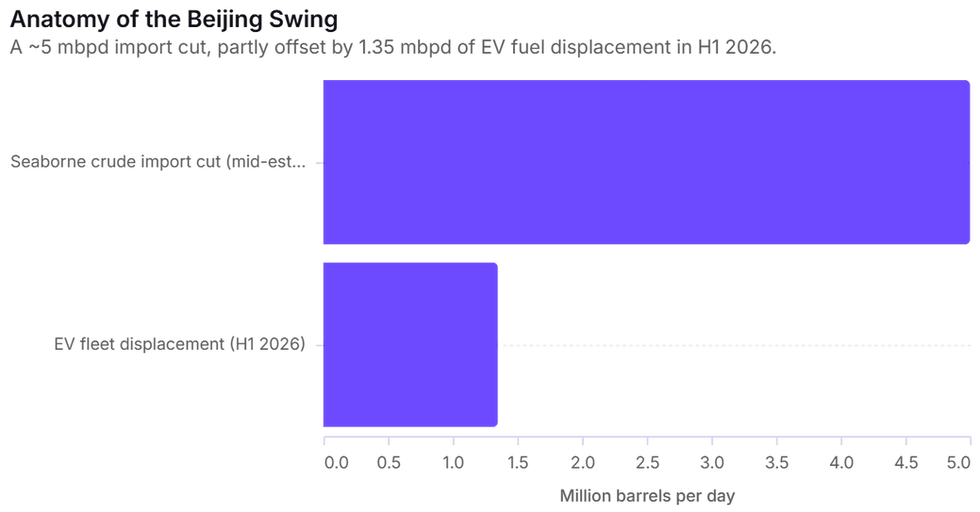
The response — dubbed the "Beijing Swing" by energy analysts — cut seaborne crude imports by approximately 5 million barrels per day through June 2026, over 40% of pre-war volumes (WSJ, Forbes), a reduction Goldman Sachs Research independently estimated at around 5 million bpd and roughly 50% (Yahoo Finance, OilPrice). The drawdown of strategic reserves absorbed the shock: reserves stood approximately 600 million barrels above U.S. levels at the crisis peak, allowing the market to escape what one analyst called "oil at close to $200 a barrel" had imports continued (The Dispatch, 11 August 2026). EV adoption alone displaced an estimated 1.35 million bpd in H1 2026 (Yahoo Finance, OilPrice), behavioural shifts pushed consumers onto public transport, and export restrictions retained domestic fuel supply. Beijing then bought the dip as the Strait reopened, replenishing inventories at lower prices. The macro effect was stabilizing — steady sequential GDP growth despite the disruption (CFR, 28 August 2026).
The ceiling, however, was exposed at the same time. Import dependence remains roughly 75% of oil consumption, about half sourced from the Middle East, with 45-50% of crude imports transiting Hormuz and much of the remainder funneled through the Malacca chokepoint whose geometry is mapped in our Malacca Strait 2026 assessment — the vulnerability no reserve accumulation fully mitigates. The IMF's August warning carries the strategic weight: "The world survived a major oil shock, but is now more vulnerable... The next shock will hit a system with less ability to absorb it" (IMF, 21 August 2026). As CFR's Clara Gillispie put it: "China's shield is not yet entirely airtight" (CFR, 28 August 2026).
For organisations with energy exposure: model the Beijing Swing as a one-time shock absorber, not a standing capability. Baseline: ~75% import dependence; ~50% of imports from the Middle East; 45-50% of crude transiting Hormuz; a reserve buffer materially thinner than six months ago. Hedge at $90-$120 per barrel for the next twelve months; stress-test against $150+ under Scenario C; and treat a concurrent Malacca or Hormuz disruption as a named, pre-mapped event — the system demonstrably absorbs one shock per cycle, not two.
7. The Demographic Ceiling: The Slow-Burning Constraint Beneath Everything
Every variable analysed above — growth, military readiness, technological ambition, coercive capacity — operates inside a constraint that no policy reverses. The demographic trajectory is not one input among many. It is the substrate.
The numbers frame it plainly. The population fell for a second consecutive year in 2025 (UPI, 2 August 2026); births collapsed to 7.92 million — barely more than half the 12.7 million university graduates entering the labour market in 2026, and an extraordinary figure for a country of 1.4 billion (UPI, 2 August 2026). More than 50,000 schools have closed in recent years as the child cohort shrinks. By end-2025, 323.38 million people were aged 60 or older — 23% of the population, up from 220 million in 2015 (UPI, 2 August 2026). The working-age population has passed its peak, with major studies projecting a loss of roughly a quarter of the workforce by mid-century; the population could shrink to 1.3 billion by 2050 and 633 million by 2100 (SCMP, population projections). Youth unemployment hovers near 16% — roughly double its post-2008 level (LBBW, 21 August 2026).
The interaction effects are where the analysis earns its keep. Ageing suppresses domestic consumption precisely when the economy needs it to offset property contraction; it inflates pension and healthcare costs precisely when land-sale fiscal capacity has halved; it shrinks the labour force at the moment the military and manufacturing base need human capital to sustain expansion. The Atlantic Council's assessment frames the strategic window with precision: the pace of decline is slow enough that Beijing "will likely have many more years to exploit its current strengths" — and a counterstrategy premised on waiting out that decline "is not a strategy, but a wager on time" (Atlantic Council, 28 August 2026).
The corollary is the behavioural driver of everything else in this assessment: the leadership knows the clock is running, and the knowledge shapes strategy. The compression of ambition — self-sufficiency, readiness, normalization, institutionalization, all accelerated before the window narrows — is not accidental. It is the rational response of a system that can read its own actuarial tables. Within this decade, demographic drag moving from background condition to binding constraint on growth and defence spending simultaneously is likely; within the twelve-month horizon of this analysis, it operates through fiscal arithmetic rather than headline events.
For organisations with long-horizon exposure: embed the trajectory in capital planning, not commentary. Baseline: births of 7.92 million against 12.7 million graduates; 23% of the population over 60; a workforce down ~25% by mid-century; youth unemployment near 16%. Labour-cost assumptions, consumer-market sizing and pension-adjacent sector models all require revision on these figures — the constraint arrives in years, but compounds continuously.
8. The Russia Symbiosis: No Limits, Defined by Limits
The "no limits" partnership declared in February 2022 has matured through 2026 into something its declaration never specified: a functional symbiosis deeper than rhetorical alignment, shallower than treaty alliance — and the gap between the two is where the strategic risk actually lives.
The military dimension has expanded visibly. The Economist assessed in July that the eastern partner is gaining "troubling military know-how from Russia" through joint exercises, technology transfer and operational coordination spanning the Arctic to the Middle East (The Economist, 23 July 2026). The "Eagles of Civilization" joint air exercises at Egyptian bases in August signalled a new security dimension to Belt and Road engagement in the Middle East and Africa (Modern Diplomacy, 29 August 2026), and announced Arctic cooperation on navigation and resource development has drawn U.S. concern — the northern dynamics of which are examined in our Arctic 2026 analysis.
The institutional architecture is densifying around it. The Shanghai Cooperation Organisation — now including India, Pakistan, Iran and Belarus, with dialogue partners from Cairo to Abu Dhabi — will launch a joint Development Bank at its 2026 heads-of-state meeting, funding infrastructure aligned with the Belt and Road agenda (ODI, 13 August 2026). Its evolution from border-dispute forum to vehicle for Eurasian integration reflects the strategic objective our Central Asia 2026 and Russia 2026 analyses track from both ends: a multi-polar order under Beijing's leadership, posed against the Western-led system (China Media Project, 26 August 2026). The U.S.-China Economic and Security Review Commission notes that Belt and Road projects increasingly incorporate military-related facilities, while global police-training programmes extend the security footprint beyond traditional military cooperation (USCC 2025 Annual Report, Congress.gov, 12 August 2026).
The limits are structural and stated. The Swedish National China Centre's February assessment captures it: the partnership offers partners "economic lifelines and diplomatic cover — not military guarantees" (Swedish National China Centre, cited in USCC Fact Sheet, 20 August 2026). Russia provides technology, energy and UN cover; the eastern partner provides markets, capital and sanctions-evasion infrastructure. Neither side has committed to mutual defence. The ambiguity is deliberate — a deterrent tool in peacetime. It is also a miscalculation vector in crisis: if a Taiwan contingency intersects with a Russia-NATO escalation, whether Moscow opens a second front — or expects reciprocity it will not receive — becomes operationally critical, a dynamic our Japan 2026: The Porcupine Paradox assessment maps from Tokyo's hedging side. Formalization of the arrangement into a defence commitment remains highly unlikely before the 2027 Congress — the ambiguity is the asset.
For organisations with Eurasian infrastructure, energy or sanctions-compliance exposure: treat the SCO stack as an emerging parallel institutional layer. Baseline: an SCO Development Bank launching in 2026; joint exercises from the Mediterranean to the Arctic; no mutual-defence clause in the partnership; sanctions-evasion infrastructure that is the primary Western enforcement target. Screen counterparties for indirect linkage to the military-facility dimension of Belt and Road projects flagged by the USCC.
9. China 2026 Geopolitical Risk Assessment — Three Scenarios
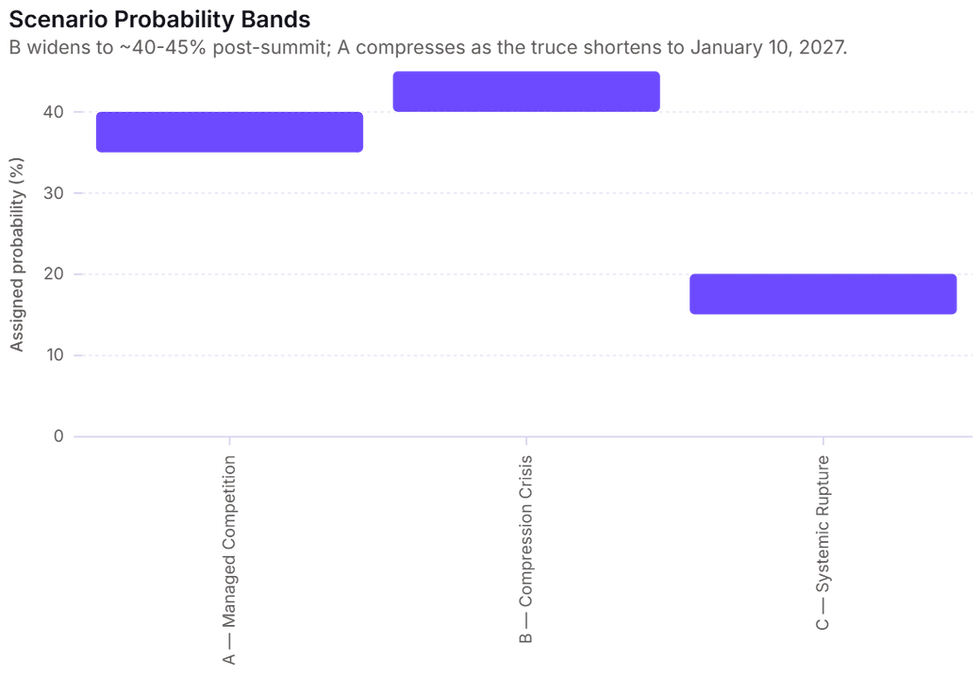
Scenario A — Managed Competition and Internal Consolidation (Probability: ~35-40%)
The September 24 Trump-Xi state visit in Washington produces a durable, if narrow, stabilization. The visit — Xi's first to the U.S. capital in more than a decade, greeted with full state protocol — extended the Busan truce by two months to 10 January 2027, cut tariffs on roughly $30 billion of goods, launched a bilateral AI dialogue, and identified more than 1,600 products for potential tariff reduction. In this scenario, that arrangement is rolled over through 2027: the truce is renegotiated at or before its January expiry, growth settles around 4-4.5% without a hard landing, the PLA purge proceeds without a visible operational failure, and grey zone coercion persists at elevated-but-stable levels without producing a kinetic incident. Xi secures his position through the October plenum and the 2027 Party Congress; the semiconductor bifurcation deepens without forcing multinationals to choose overnight; the Russia partnership deepens incrementally without crossing into alliance. This scenario holds because both leaders have demonstrated they prefer managed rivalry to rupture, and because the two-month extension — short of the six months analysts expected — reflects a mutual desire to keep negotiating rather than a mutual inability to.
This scenario fails if one or more triggers fire: the truce lapses on 10 January with tariff rates reverting upward; Beijing's unmet commitments on agricultural purchases and rare earths become a U.S. enforcement pretext; a kinetic incident in the South China Sea or Taiwan Strait escalates beyond either capital's intent; or a PLA equipment failure during a live-fire exercise exposes the purge's operational costs at scale.
Scenario B — Compression Crisis: Grey Zone Escalation and Economic Deterioration (Probability: ~40-45%)
One or more incidents escalate beyond intended parameters. A Philippine vessel is sunk, or a Taiwanese coast guard ship is fired upon, drawing in U.S. naval assets; or the January truce expiry reopens the tariff corridor amid a U.S. midterm season that rewards demonstrations of strength. Simultaneously, the economic slowdown accelerates: property defaults cascade — recall that the reserve buffers documented in Section 6 are thinner, not thicker — deflation deepens, youth unemployment pushes past 18%, and local-government debt forces a choice between bailouts and social spending. The PLA, mid-purge and under pressure to demonstrate capability before August 2027, conducts an exercise near the island that Taipei reads as a blockade precursor. The island mobilizes; the U.S. deploys; the crisis resolves through de-escalation — but not before markets reprice, capital outflows accelerate, and supply chains across the Indo-Pacific are disrupted for weeks.
The probability band is elevated relative to the pre-summit baseline because the stabilizer — the truce — is now explicitly short-dated, and because the September expulsion of the two most senior purged generals removes any prospect of command-level dampening before the plenum. It does not sit higher because both capitals have just invested heavily in the optics of state-visit diplomacy, and each escalation cycle since 2025 has ended in negotiated landing zones rather than uncontrolled spirals.
Scenario C — Systemic Rupture: Taiwan Contingency and Global Reordering (Probability: ~15-20%)
A convergence of pressures — economic deterioration, a perceived U.S. distraction (Iran war sequel, Atlantic strain, domestic crisis), a PLA leadership eager to prove capability before the 2027 Congress, and a Taipei policy shift read in Beijing as a declaration of independence — produces a decision to quarantine or blockade the island. The militia-coast guard "L-shaped" array model tested in January 2026 executes at scale, supplemented by PLAN and Rocket Force assets. The U.S. responds with carrier deployment and sanctions; Beijing retaliates with rare-earth export restrictions, cyber operations against critical infrastructure, and an SCO diplomatic offensive. TSMC operations are disrupted; the global tech sector tips into recession; Moscow probes in Ukraine or the Baltic theatre against the U.S. bandwidth deficit. The rules-based order fractures.
The probability remains the lowest of the three because it requires multiple variables to align unfavourably at once, and the January-model array — while proven as harassment — remains untested against concerted naval resistance. It is nonetheless higher than a year ago on three elevators: the purge-induced command volatility documented in Section 2, the normalization of presence that lowers the escalation threshold each month (Section 5), and the compression of Xi's timeline before the Party Congress — with the two-month truce offering only a thin diplomatic buffer over the most dangerous window.
10. Implications
For supply chain resilience teams: model a permanently bifurcated semiconductor market. The assumption that export controls would prevent indigenous capability has been falsified at mature nodes; the assumption that the indigenous ecosystem matches the frontier is equally false. Plan for two parallel ecosystems with rising regulatory pressure to declare allegiance. Stress-test against Scenario B disruptions: a South China Sea shipping interruption of 2-4 weeks combined with Taiwan Strait instability. Identify single-source dependencies on TSMC and qualify alternatives now — not during a crisis.
For energy procurement teams: treat the Beijing Swing as a spent absorber. Reserve drawdown during the Hormuz crisis means the next disruption hits a thinner buffer. Model a concurrent Malacca and Hormuz disruption as a named scenario. Hedge exposures at $90-$120 per barrel over twelve months; stress-test against $150+ under Scenario C.
For corporate strategy and M&A teams: reprice exposure against fundamental deceleration. The 4.3% Q2 reading is the trajectory, not a trough. Model revenue growth at 2-4% nominally, property drag persisting 3-5 years, and deflationary export pressure continuing to reshape trade flows. Track the 10 January truce expiry as a dated repricing event: the summit's two-month extension buys negotiation time, not settlement.
For risk and security teams: elevate threat levels on critical infrastructure. Cyber operations against logistics, financial and energy targets in the Indo-Pacific must be assumed to accompany any cross-strait crisis — and the command vacuum documented in Section 2 increases the probability that such operations run with reduced civilian oversight.
For board-level scenario planners: incorporate the demographic trajectory into long-range forecasts now. The 7.92 million births against 12.7 million graduates is not a 2030s statistic — it is constraining consumption, fiscal capacity and defence manpower today. Integrate the October plenum and the January truce expiry as the two dated markers of the next ninety days.
11. Core Analytical Judgment
The PRC in 2026 is a system under simultaneous compression — economic, military, technological, demographic, and geopolitical — at the precise moment its leadership is consolidating for a fourth term and a Party Congress that will define the next decade. The compression is not a crisis. It is a condition. And it is producing a strategic behaviour pattern that is both rational and dangerous: accelerated ambition compressed against a narrowing window.
The economy has entered a lower-growth equilibrium that no stimulus reverses, because the foundational drivers of the previous model — property investment, demographic dividend, export-led expansion — are exhausting simultaneously. The military is being purged and rebuilt mid-operation: a command vacuum degrading readiness in the short term while concentrating decision authority at the apex in the medium term, and the September expulsions converted an anti-corruption campaign into an open question about war-waging capacity itself. The tech war has failed to contain the country and has instead financed a parallel ecosystem that bifurcates the semiconductor market permanently — even as the frontier gap persists. The grey zone machine has normalized coercion to a degree that makes unintended escalation statistically more probable each month. The demographic clock ticks loudly enough to shape strategic timelines and slowly enough to deny the comfort of imminent collapse. And the Russia symbiosis deepens in deliberate ambiguity — an asset in deterrence, a vector in miscalculation.
The Washington summit changed none of this. It bought sixty days.
The overstretch is real. But overstretch is not collapse. The leadership is aware of the compression and behaves strategically — accelerating what can be completed before the window narrows, containing what cannot be resolved. The question is whether the acceleration produces a strategic error — in the Strait, in the South China Sea, in a degraded command chain, or in the interaction of economic deterioration with political legitimacy — that exceeds the capacity to manage.
The overstretch is the strategy. The question is whether the strategy holds.
---
Want deeper analysis?
Bespoke advisory and theatre-level assessments are available on request — scenario planning, country and sector deep dives, crisis stress-testing, and board-level briefings. Engagements are confidential.
Thierry Marquez — Founder & Principal Advisor, CES Intelligence
+33 (0)9 55 16 54 98 →
DISCLAIMER
This analysis is provided for informational and strategic planning purposes only. It is not investment advice, financial advice, or legal advice, and it should not be treated as such. Probability assessments reflect the analyst's calibrated judgment based on available open-source intelligence as of the date of publication and are subject to revision as new information emerges. Some quantitative estimates and reported events are based on regional sourcing that may evolve as additional confirmation becomes available.


